
Fannie Mae vs. Freddie Mac: Key Differences That Can Affect Mortgage Approval Most borrowers have…
Large Bank Deposits and Mortgage Approval: What Borrowers Should Know
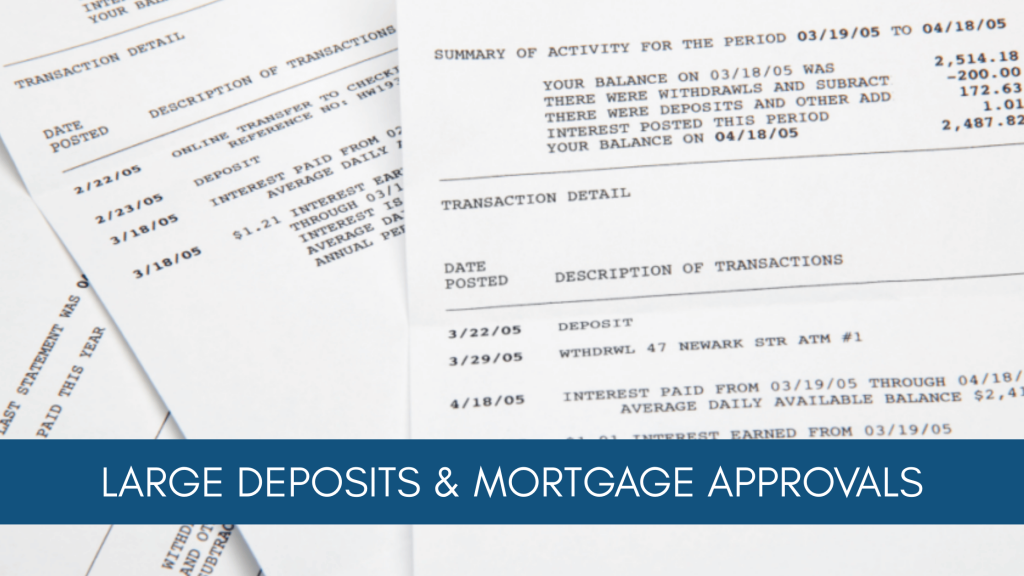
Large Bank Deposits and Mortgage Approval: What Borrowers Should Know
Mortgage underwriting requires lenders to verify the funds used for a home purchase. One lesser-known guideline under Fannie Mae’s asset verification rules involves large or unusual deposits appearing in a borrower’s bank statements. When deposits appear that are inconsistent with normal account activity, lenders must document the source of those funds before they can be used for down payment, closing costs, or mortgage reserves.
Borrowers are often surprised when lenders ask about these deposits. Understanding why this happens can help avoid delays and make the mortgage process smoother.
Why Lenders Review Bank Deposits
Mortgage underwriting requires lenders to verify that the funds used in a real estate transaction come from acceptable and documented sources. This review serves two important purposes. First, it confirms that the borrower has sufficient funds available for the down payment and closing costs. Second, it helps ensure that funds used in the transaction are legitimate and properly sourced.
Financial institutions must also follow regulations designed to prevent fraud and money laundering. Because of this, lenders must confirm where funds originate when they appear in a borrower’s account. For borrowers, this can feel surprising. A deposit that seems routine may still require explanation simply because the lender must document the source.
The goal is not to question the borrower’s finances, but to ensure that all funds used in the transaction are properly verified.
What Counts as a Large Deposit?
Fannie Mae guidelines do not define a specific dollar amount that qualifies as a large deposit. Instead, the size of the deposit is evaluated relative to the borrower’s normal account activity.
For example:
- A $3,000 deposit in an account that typically carries $80,000 may not raise questions.
- A $3,000 deposit in an account that usually holds $5,000 may prompt additional review.
Underwriters generally look for deposits that appear inconsistent with the normal flow of funds through the account.
When a deposit stands out, the lender may simply ask the borrower to explain where the funds came from.
The Lesser-Known Guideline Behind Large Deposit Questions
Under Fannie Mae guidelines, lenders must verify the source of funds used in a mortgage transaction. If a large deposit appears in a borrower’s account and the source cannot be documented, those funds generally cannot be counted toward the borrower’s assets for qualification purposes.
This rule often surprises borrowers because the money may already be sitting in their bank account. However, mortgage underwriting requires documentation showing where the funds originated. If the source is verified, the funds can typically be used without issue. If the source cannot be documented, the lender may simply exclude the deposit from the borrower’s available assets.
Because assets influence factors such as down payment, reserves, and overall loan strength, properly documenting large deposits can play an important role in the approval process.
Example of a Verified Large Deposit
Many large deposits are easily verified once the source is explained.
For example, a borrower may sell a car before purchasing a home. If the borrower deposits $8,500 from the sale of the vehicle, the underwriter may request documentation confirming the transaction.
Acceptable documentation might include:
- A bill of sale
- Evidence of the buyer’s payment
- A copy of the transferred title
Once the source is documented, the funds can typically be included as part of the borrower’s available assets.
Situations like this are common and usually straightforward to verify.
Other Common Verified Sources of Large Deposits
Large deposits frequently come from legitimate financial events. Some examples include:
- The sale of a vehicle or personal property
- A tax refund
- A year-end bonus from an employer
- Transfers between the borrower’s own accounts
- Gift funds from eligible family members
- Proceeds from selling investments
Income-related deposits such as bonuses or commissions may already be part of the borrower’s qualifying income. These income sources are discussed further in When One Year of Bonus or Overtime Income May Be Enough for Mortgage Qualification and Understanding the 25 Percent Rule for Commission Income.
When documentation clearly explains the source of the funds, these deposits typically do not create issues during underwriting.
Gift Funds and Large Deposits
Family gift funds are often used to help with down payments.
When gift funds appear as a deposit in a borrower’s account, lenders generally require documentation to confirm that the funds are truly a gift rather than a loan.
This documentation may include:
- A signed gift letter
- Evidence of the donor’s ability to provide the funds
- Documentation confirming the transfer of funds
Gift funds are commonly used alongside smaller down payment programs, which are discussed in Low Down Payment Conventional Loan Options.
Can You Deposit Cash Before Applying for a Mortgage?
Borrowers sometimes wonder whether depositing cash before applying for a mortgage will create problems during underwriting. Small and routine deposits are usually not an issue. However, large cash deposits can create challenges because they are difficult to document. Unlike electronic transfers, payroll deposits, or asset sales, cash deposits often do not provide a clear record of where the funds originated.
For this reason, lenders may ask borrowers to explain large cash deposits that appear on bank statements. If the source of the funds cannot be verified, the deposit may not be eligible to count toward down payment or reserve funds.
Borrowers preparing to apply for a mortgage often benefit from keeping financial activity straightforward and well documented.
Large Deposits and Mortgage Reserves
Large deposits may also affect how mortgage reserves are calculated. Mortgage reserves represent funds remaining after closing that can support future mortgage payments. Strong reserves can strengthen a borrower’s financial profile, particularly when debt-to-income ratios are elevated.
This concept is explored further in Mortgage Reserve Requirements Under Fannie Mae and When a Higher Debt-to-Income Ratio Can Still Be Approved.
If a deposit cannot be documented, the funds may be excluded from reserve calculations even if they remain in the account.
Preparing Bank Statements Before Applying
Borrowers often benefit from reviewing their financial accounts before applying for a mortgage.
Simple steps can make the documentation process easier:
- Maintain records for large asset sales
- Document transfers between accounts
- Avoid depositing large amounts of cash without a clear paper trail
- Keep statements for accounts that will be used in the transaction
These small preparations can help the underwriting process move more smoothly.
A Practical Perspective on Large Deposits
One of the lesser-known Fannie Mae guidelines involves documenting the source of funds used in a mortgage transaction. This is why lenders review large deposits that appear in bank statements. In most cases, deposits can be easily documented once their origin is explained. Transfers between accounts, asset sales, bonuses, or family gifts are commonly accepted when properly verified.
The key is transparency and documentation.
Mortgage underwriting evaluates the borrower’s complete financial profile, including income stability, assets, debt structure, and reserves. When these elements are clearly documented, the process tends to move forward efficiently.
Understanding how large deposits are reviewed helps borrowers approach the mortgage process with greater preparation and confidence.
Frequently Asked Questions
Do lenders always ask about large deposits?
Lenders review bank statements to verify the source of funds used in the transaction. Deposits that appear unusually large compared with normal account activity may require explanation.
Can gift money appear as a large deposit?
Yes. Gift funds from eligible family members are commonly used for down payments. Lenders typically require a signed gift letter and documentation confirming the transfer of funds.
Continue Reading: Conventional Loan Qualification Guides
For additional insight into how conventional mortgages are evaluated, the following articles expand on related topics:
- 10 Lesser-Known Fannie Mae Guidelines That Can Influence Mortgage Qualification
- When a Higher Debt-to-Income Ratio Can Still Be Approved
- When One Year of Bonus or Overtime Income May Be Enough for Mortgage Qualification
- Mortgage Job History Requirements: What Fannie Mae Actually Looks For
- Mortgage Reserve Requirements Under Fannie Mae
- When Installment Debt Can Be Excluded From Debt-to-Income Calculations
- Understanding the 25 Percent Rule for Commission Income
- Using Rental Income to Qualify for a New Home Purchase
- Low Down Payment Conventional Loan Options
- Fannie Mae vs. Freddie Mac: Key Differences That Can Affect Mortgage Approval

