
For employees at large private companies, the relationship between equity compensation and mortgage qualification often…
DSCR Loans for 5 to 8 Unit Multi-Family Properties
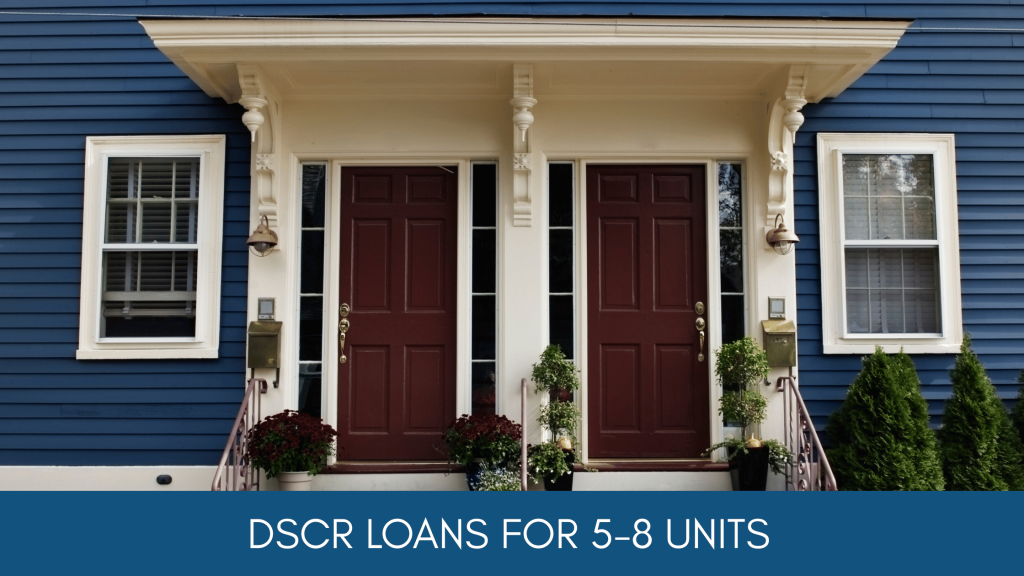
DSCR Loans for 5 to 8 Unit Multi-Family Properties
Properties with 5 to 8 residential units often fall into a financing gap in the lending market. They are too large for most residential mortgage programs but still smaller than the apartment properties many commercial lenders typically finance.
Most residential loan programs stop at 4 units. Once a property reaches 5 units, lenders frequently begin treating it as a commercial asset.
This creates challenges for investors purchasing multi-family properties with 5 to 8 units.
DSCR loans help bridge this gap.
Instead of focusing primarily on the borrower’s personal income, DSCR loans evaluate whether the property generates enough rental income to support the mortgage payment.
For investors purchasing or refinancing a 5 to 8 unit multi-family property, DSCR financing provides a structure that sits between residential and commercial lending.
If you are new to this loan type, it helps to begin with What Is a DSCR Loan and How It Works for Investors, which explains the fundamentals of DSCR underwriting.
Quick Summary: DSCR Loans for 5 to 8 Unit Properties
DSCR loans allow certain multi-family properties to qualify for financing based on the income produced by the property rather than the borrower’s personal income.
Typical characteristics of DSCR loans for 5 to 8 unit properties include:
- Properties containing 5 to 8 residential units
- Minimum DSCR ratios around 1.00
- Loan amounts typically ranging from $250,000 to $3,000,000
- Down payments commonly between 25 percent and 30 percent
- Reserve requirements often beginning at 6 months of mortgage payments
Because these properties sit between residential and commercial lending categories, DSCR loans provide an alternative financing option for investors purchasing multi-family properties in this range.
A deeper explanation of underwriting guidelines can be found in DSCR Loan Requirements for 5 to 8 Unit Properties.
What Is a DSCR Loan
DSCR stands for Debt Service Coverage Ratio.
It is the metric lenders use to determine whether a property produces enough income to cover its mortgage payment.
The calculation is straightforward.
Monthly rental income divided by the monthly mortgage payment.
The mortgage payment usually includes principal, interest, property taxes, insurance, and association dues if applicable.
Many DSCR programs for multi-family properties allow a minimum DSCR ratio of 1.00. This means the rental income simply needs to cover the mortgage payment.
If rental income exceeds the mortgage payment, the DSCR ratio increases and the property produces positive cash flow.
For investors analyzing potential deals, understanding this calculation is essential. A detailed walkthrough can be found in How to Calculate DSCR for Multi-Family Properties.
Why DSCR Loans Exist for 5 to 8 Unit Properties
The reason DSCR loans exist for properties with 5 to 8 units comes down to how lenders categorize real estate.
Residential mortgage programs are designed primarily for properties with 1 to 4 units. These loans evaluate the borrower’s personal income and follow standardized underwriting guidelines.
Once a property reaches 5 units, it typically falls outside these residential programs.
Commercial apartment loans often target much larger properties and may require extensive financial documentation, operating statements, and more complex underwriting.
Multi-family properties with 5 to 8 units sit between these two categories.
They are too large for most residential financing but smaller than the properties many commercial lenders prefer to finance.
DSCR loans help address this gap by focusing on the income generated by the property itself.
Can You Use DSCR Loans for 5 to 8 Unit Properties
Yes, although these programs are more specialized than DSCR loans used for 1 to 4 unit rental properties.
Not every lender offers DSCR financing for multi-family properties with 5 to 8 units. Programs that do exist tend to follow more specific underwriting guidelines.
When evaluating these loans, lenders typically review several factors including:
- The property’s rental income
- The DSCR ratio
- The borrower’s credit profile
- Reserve requirements
- Investor experience
Because properties with multiple units involve more tenants and operational complexity, lenders often require stronger reserves and documentation compared with smaller rental properties.
DSCR Loan Requirements for 5 to 8 Unit Properties
While guidelines vary between lenders, most programs for multi-family properties with 5 to 8 units follow similar underwriting standards.
The most important factors lenders evaluate include DSCR ratio, credit score, reserves, and investor experience.
A detailed breakdown can be found in DSCR Loan Requirements for 5 to 8 Unit Properties.
Minimum DSCR
Many programs require a minimum DSCR ratio of 1.00.
Credit Score
Credit score influences how much financing an investor may qualify for.
Many programs require a minimum score around 680, although stronger credit profiles may qualify for higher leverage.
Investors interested in leverage differences should review How Credit Score Impacts DSCR Loan Leverage.
Investor Experience
Because managing a multi-family property requires operational experience, some lenders require prior ownership or management of income producing real estate.
Cash Reserves
Most DSCR programs require at least 6 months of mortgage payments held in reserve.
Loans above $1.5 million may require 9 months of reserves.
For more details see How Much Cash Do You Need to Close a Multi-Family DSCR Loan.
Loan Amounts and Leverage
DSCR loans for multi-family properties often support larger loan amounts than traditional residential mortgages.
Loan sizes frequently begin around $250,000 and may extend to approximately $3,000,000 depending on the lender and property characteristics.
Maximum leverage for purchases and rate and term refinances often reaches approximately 75 percent loan to value for qualified borrowers.
Cash out refinances generally allow lower leverage limits.
Down Payments for 5 to 8 Unit DSCR Loans
Down payments for multi-family properties with 5 to 8 units are typically higher than those required for residential rental properties.
Most investors should expect down payments between 25 percent and 30 percent depending on credit score, DSCR ratio, and property performance.
For example, a property purchased for $1,000,000 at 75 percent financing would require a down payment of $250,000 plus closing costs and reserves.
A deeper breakdown of leverage and capital requirements can be found in DSCR Loan Down Payments for 5 to 8 Unit Properties.
How Lenders Evaluate Rental Income
Rental income plays a central role in DSCR underwriting.
For leased units, lenders usually use the lower of the lease amount or the market rent established in the appraisal.
Vacant units are often counted at 75 percent of market rent, and lenders typically limit the number of vacant units allowed at closing.
Short term rental income is generally not included when calculating DSCR for multi-family properties.
Investors evaluating properties with vacancy should review How Vacancies Affect DSCR Loan Qualification.
Property Eligibility
Not every property qualifies for DSCR financing.
Typical property requirements include:
- Residential properties containing 5 to 8 units
- Properties located in non rural areas
- Properties generally limited to 2 acres or less
- Properties free of structural issues or major deferred maintenance
Investors evaluating potential acquisitions may want to review What Properties Qualify for Multi-Family DSCR Loans.
Frequently Asked Questions
Can DSCR loans be used for 5 to 8 unit properties
Yes. Certain DSCR programs allow financing for multi-family properties with 5 to 8 units.
What DSCR ratio is required
Many programs allow a minimum DSCR ratio of 1.00.
How much down payment is required
Most investors should expect down payments between 25 percent and 30 percent depending on credit score and property performance.
Can DSCR loans be used for refinancing
Yes. DSCR loans may be used for purchases, rate and term refinances, and cash out refinances.
Next Steps for Investors
Properties with 5 to 8 units represent an important step for many investors expanding beyond residential rental properties.
Because these properties fall between residential and commercial lending categories, understanding DSCR underwriting can help investors structure financing more effectively.
Investors researching DSCR financing often continue exploring topics such as leverage limits, underwriting requirements, and capital planning.
If you are currently evaluating a 5 to 8 unit property and want to understand how DSCR financing may apply to your investment strategy, speaking with a lender experienced in DSCR lending can help clarify leverage limits, reserve requirements, and how the property’s rental income will be evaluated.
You can explore those topics further in:
DSCR Loan Requirements for 5 to 8 Unit Properties
DSCR Loan Down Payments for 5 to 8 Unit Properties
How to Calculate DSCR for Multi-Family Properties
How Credit Score Impacts DSCR Loan Leverage
How Vacancies Affect DSCR Loan Qualification
What Properties Qualify for Multi-Family DSCR Loans
How Much Cash Do You Need to Close a Multi-Family DSCR Loan
DSCR Cash Out Refinance for Multi-Family Properties

