When you're buying a home in California, you often run into loan amounts that exceed…
Minimum Down Payment for a House in California: FHA 3.5% Rule and Average Buyer Investment
Buying a home in California is exciting, but most buyers quickly realize that the biggest challenge is often the down payment.
Home prices here are higher than the national average, and saving enough money upfront can feel like the biggest barrier to getting started. Many buyers assume they need to put 20% down to purchase a home, but several loan programs allow qualified borrowers to buy with far less.
In this guide, we’ll explain the minimum down payment for a house in California, how the FHA 3.5% down payment rule works, what buyers typically put down, and where your funds can come from.
FHA loans are commonly used by buyers throughout California, including markets such as the Bay Area, Sacramento, Los Angeles, and San Diego. At Bridgepoint Funding, we help buyers in these markets evaluate different mortgage programs so they can choose the option that best fits their financial situation.
Key Takeaways
- The minimum down payment for a house in California using an FHA loan is 3.5% if your credit score is 580 or higher.
- FHA loans allow buyers to finance up to 96.5% of the home price, making them one of the most accessible mortgage programs.
- Buyers with credit scores between 500 and 579 must put down at least 10%.
- FHA guidelines allow down payment funds to come from savings, gift funds, or approved assistance programs.
- Some conventional loans allow as little as 3% down, but they often require stronger credit profiles.
What Is an FHA Loan?
An FHA loan is a mortgage insured by the Federal Housing Administration, a government agency created to expand access to homeownership.
Because the loan is backed by federal insurance, lenders can offer more flexible approval guidelines than many conventional mortgage programs.
FHA loans are known for several key benefits:
- Lower down payment requirements
- More flexible credit standards
- Higher allowable debt-to-income ratios
- Availability for first-time and repeat buyers
The feature most buyers notice first is the 3.5% down payment option, which allows qualified borrowers to purchase a home with a much smaller upfront investment than traditional mortgage programs.
If you’d like a deeper explanation of the program, you can review. You can also learn more directly from the FHA.
What Is the Minimum Down Payment for a House in California with an FHA Loan?
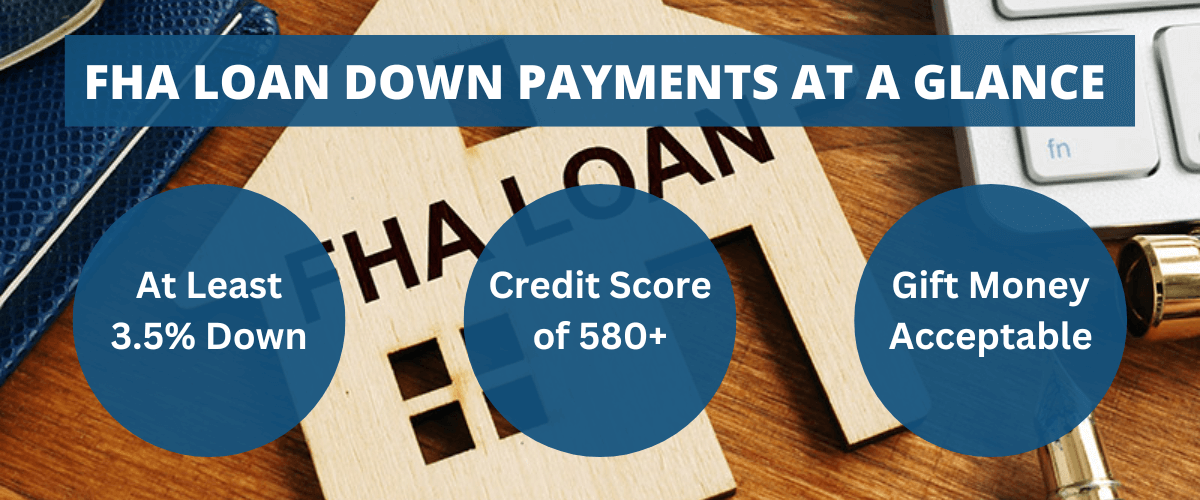
The minimum down payment for a house in California using an FHA loan is 3.5% of the purchase price, provided the borrower has a credit score of 580 or higher. FHA loans allow buyers to finance up to 96.5% of the home’s value, making it one of the most accessible mortgage programs for many first-time homebuyers.
This requirement comes from FHA guidelines called the Minimum Required Investment (MRI). The MRI represents the portion of the purchase price that must come from the borrower or an approved source.
Under FHA guidelines:
- Borrowers can finance up to 96.5% of the home price
- The buyer contributes 3.5% toward the purchase
- A credit score of 580 or higher qualifies for the minimum down payment option
Minimum Investment at Different Price Points
Percentages are helpful, but most buyers want to see the numbers in real dollars.
While the average down payment on a house in California varies widely depending on the market and the buyer’s finances, FHA loans allow buyers to purchase a home with a relatively small initial investment.
Here are examples of the 3.5% FHA down payment at different home prices:
| Home Price | FHA Minimum Down Payment |
| $500,000 | $17,500 |
| $600,000 | $21,000 |
| $700,000 | $24,500 |
| $800,000 | $28,000 |
| $900,000 | $31,500 |
| $1,000,000 | $35,000 |
In many California markets, buyers put down more than the minimum simply to remain competitive in multiple-offer situations. However, FHA financing still allows many qualified buyers to enter the housing market with a relatively modest upfront investment.
For more information, see our guide on low down payment programs for first-time buyers.
Example: Buying a Home in California with 3.5% Down
Let’s look at a simple example.
Imagine a buyer purchasing a $700,000 home in California using an FHA loan.
With the FHA minimum down payment requirement of 3.5%, the buyer would need:
- Down payment: $24,500
- Estimated loan amount: $675,500
This allows the buyer to purchase the home without needing a large six-figure down payment.
Many buyers choose this approach because it allows them to enter the housing market sooner, while keeping additional savings available for closing costs, reserves, or future home expenses.
How Your Down Payment Affects Your Monthly Payment
While FHA loans allow buyers to purchase a home with as little as 3.5% down, the amount you choose to put down can still affect several parts of your mortgage.
A larger down payment can:
- Reduce your monthly mortgage payment
- Lower the amount you borrow
- Decrease your loan-to-value ratio (LTV)
- Reduce the total interest paid over time
For example, putting an additional $10,000 toward the purchase of a home directly lowers the loan amount and can make the monthly payment more comfortable.
Some buyers prefer the minimum down payment to preserve savings, while others choose to invest more upfront to reduce long-term borrowing costs.
Credit Score Requirements for the 3.5% Option
Your credit score plays an important role in determining the required down payment.
Here is how FHA guidelines break down:
Credit score 580 or higher
- Eligible for 3.5% minimum down payment
Credit score 500–579
- Minimum down payment increases to 10%
Credit score below 500
- Generally not eligible for FHA financing
Because of this threshold, improving your credit score before applying for a mortgage can make a meaningful difference in how much cash is required.
You can learn more about how credit scores affect FHA loan eligibility on our blog.
Where Can FHA Down Payment Funds Come From?
Many buyers assume the down payment must come entirely from personal savings. FHA guidelines allow funds from several approved sources, provided they are properly documented.
Eligible sources include:
- Personal savings
- Gift funds from family members
- Employer housing assistance programs
- Down payment assistance programs
- Grants from nonprofit or government housing agencies
If gift funds are used, the donor must provide a signed gift letter confirming the funds do not need to be repaid.
However, funds cannot come from parties who benefit financially from the sale, such as:
- The property seller
- The real estate agent
- The lender
Borrowed funds also cannot be used to meet the minimum investment requirement.
The U.S. Department of Housing and Urban Development also publishes quarterly reports on FHA loan activity and market share, which show how widely the program is used by homebuyers nationwide.
FHA vs Conventional Loans
Many buyers compare FHA loans and conventional mortgages when deciding which loan program best fits their situation.
| Feature | FHA Loan | Conventional Loan |
| Minimum Down Payment | 3.5% with 580+ credit score | As low as 3% |
| Credit Flexibility | More flexible credit guidelines | Typically stronger credit required |
| Debt-to-Income Ratios | Higher ratios often allowed | Usually stricter |
| Mortgage Insurance | Required for most FHA loans | Required if under 20%, removable later |
| Best For | Buyers with moderate credit or limited savings | Buyers with stronger credit and reserves |
| Property Types | Primary residences | Primary, second homes, and investment properties |
Not sure which fits your situation? Learn more about buying a home with 3% down.
Final Thoughts
Saving for a down payment can feel like the biggest hurdle to buying a home in California, but many buyers are surprised to learn they may qualify with far less money upfront than expected.
Programs like FHA financing allow qualified borrowers to purchase a home with just 3.5% down, along with flexible credit guidelines and multiple eligible funding sources.
At Bridgepoint Funding, we work with multiple lenders and help buyers compare loan options so they can find the program that best fits their situation.
If you’re thinking about buying a home and want to better understand your options, we’re always happy to answer questions and help you explore what might work best. Contact us online or by phone.

